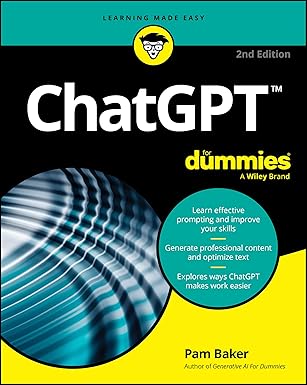
ChatGPT for Dummies (2nd Edition)
By Pam Baker
(for dummies, John Wiley & Sons, Inc.)
It is a reflection of the breakneck pace of developments in artificial intelligence that the first and second editions of Pam Baker’s ChatGPT for Dummies are ostensibly two different publications. Not only is the second edition larger and more comprehensive than the earlier edition, but it also serves as a more complete reference for ChatGPT beginners and power users alike.
Baker is eminently qualified to not only catalogue and distill the evolution of the world’s most utilised chatbot, but to also frame those developments in the context of ChatGPT itself, as well as other AI platforms, and professions likely to be impacted by take-up of the new technology.
Baker’s other work includes Generative AI For Dummies, Decision Intelligence for Dummies, and Data Divination: Big Data Strategies. She teaches as an instructor for LinkedIn Learning on the topics of AI, IT, and Innovation. She is also a speaker at technology and science conferences, and a member of the Internet Press Guild. It is safe to say that not only is she is a pioneering adopter of AI, but she is also a skilled communicator who can pass on the lessons of hours of wrestling with the technology.
While there are many differences between the first and second editions of ChatGPT for Dummies, one common overriding theme is that ChatGPT is not your friend. It does not possess intelligence, it is not 100% accurate and that you must “Always verify all responses from any generative AI model or application”.
Subjects tackled by the book range from the introductory to the practical to the speculative. Introductory topics include getting Started with ChatGPT, choosing GPT models and Warnings, Ethics and Responsible AI.
Baker then moves onto Increasing Proficiency in Prompting where she covers ChatGPT prompt basics, prompting for text versus non-text outputs, chaining prompts, specifying writing or artistic styles in prompts, and assigning roles and personas in prompts. She follows this with manipulating prompts for more refined responses including adding positive and negative directions, closed and open-ended questions, and establishing intent. There is also some advice on token limits and using custom GPTs to skirt around these.
For those after more under-the-hood technical detail, Baker covers adding data to prompts such as images and instructions, as well as explaining the temperature (randomness or ‘creativity’ in output generation) and weights (numerical values assigned to the connections between neurons) of an LLM such as ChatGPT.
She also goes into some detail in using other language models in conjunction with ChatGPT. This ‘output stitching’ or ‘model chaining’ helps users take advantage of functions ChatGPT may not be as strong in as, say, Claude or Perplexity, a user scenario which may be made easier by the roll-out of MCP (Model Context Protocol) – a standardised way to connect differing AI models to different data sources and tools.
In part three of the book, Baker delves (if we can still use that term) into ChatGPT as a replacement for traditional work processes and across disciplines such as HR, legal, journalism and finance, leveraging GPT in education, images and art, writing and editing , and video and audio production.
Lastly, Baker tackles ChatGPT in the real world, including the demise of keyword search, the rise of knowledge assistants, misinformation, and the dangers of over-reliance on ChatGPT. She concludes the book with useful and amazing things you can do with ChatGPT, as well as Ten Bold Predictions for the Future of ChatGPT and Generative AI.
All in all, this 2nd Edition of ChatGPT for Dummies, is an invaluable reference for those getting to grips with ChatGPT and those experienced users want to keep up with Open AI’s conveyor belt of new model and functionality releases. Commendably, Baker strikes the right balance of enthusiasm and caution for the technology with an emphasis on human oversight and agency. A definite must for your bookshelf or e-library.